New clients always get first 30-Min Booking free!

How Much Stimulation Does My Dog Need?
Suzanne Del
7/2/20266 min read


Still, pet parents’ endless work and household tasks make us unreliable with walks and games. We wonder if our fur friends are bored and unsatisfied.
Dogs don’t need entertainment every minute, but they do need a predictable mix of exercise, dog mental stimulation, and real human attention each day.
But how much stimulation does a dog need and in what proportion?
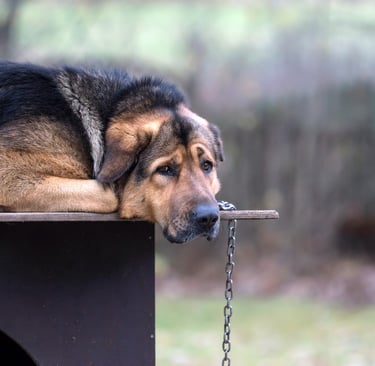
Many of us remember the days when dogs spent day and night outside chained to a dog house, often barking at us to get something, anything, going. (Even putting up this picture to the right killed me.)
Today’s dogs have warehouses of toys, chews, bedding, and even clothes.

A Clue: How Wild Dogs Spend Their Days
If dogs had all the freedom to do what they wanted when they wanted, how would they break up their days?
Hunting
Wild canids (like the African wild dog left) typically split their day between long-distance traveling around dawn and dusk and extended rest or sleep during the hotter daytime hours.
Studies and field observations show wild dogs can travel 12 to 30 or more miles in a single day as they move through their territory searching for prey. They follow game trails, chase, and if they nab that rabbit, they regurgitate meat for pups and nursing females.
African Wild Dog at rest.


Rest and Sleep
In contrast to their intense hunting bursts, wild dogs rest and sleep for much of the day, especially when temperatures are high. When you’re having those guilt pangs, remember that dogs may spend about 50% of the day asleep, 30% awake but resting, and around 20% active. During that resting time, pack members may groom each other or play with pups, reinforcing social bonds.
Beyond walking and sleeping, pack members maintain home ranges via patrolling and scent-marking boundaries with urine, feces, and scratch marks.

Your Attention Matters
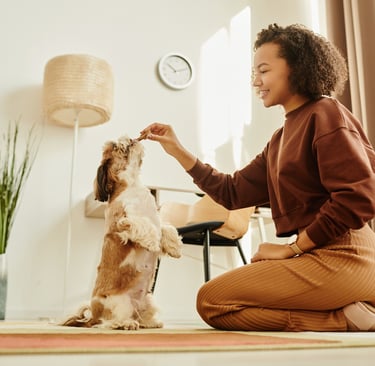
Your dog’s day is built around you. You’ve probably noticed that they wait for your next move: a walk, a cuddle, or even a quick training game. When that need for attention is met, you see fewer issues like barking, chewing, and anxiety. These activities expend your dog’s physical energy. When it’s not, that energy spills out in ways owners can find annoying or problematic.
Think of attention as three ingredients:
· 🐕 movement (exercise)
· 💡 thinking (dog mental stimulation)
· ❤️ connection (social time with you)
Of course, the balance looks different for a young Aussie than for an older Chihuahua, but all three are essential.
How Much Attention Does the Average Dog Need?
For a typical, healthy adult dog, a solid daily target is:
· ✅ 30–90 minutes of purposeful movement (walks, play, hiking, swimming), scaled up for high-energy breeds and down for seniors or low-energy dogs.
· ✅ 20–40 minutes of daily enrichment for dogs through training games, puzzle feeders, nosework, and sniffy walks.
· ✅ 20–40 minutes of focused social time (affection, grooming, calm hanging-out where your dog feels included).
That doesn’t mean you must carve out three separate hours of “dog entertainment.” You’re likely already hitting pieces of this in short bursts: a morning walk, a training game before dinner, snuggle time on the couch. The key is consistency and variety, not perfection.
If you’ve ever wondered how much stimulation does a dog need, the answer is usually a healthy mix of physical exercise, dog mental stimulation, and connection spread throughout the day.
Active Engagement vs. “Hanging Out”
Pet parents often ask: “Does my dog need me playing with them, or is being home together enough?”
Focused attention counts more than passive time. When your dog clearly knows you’re interacting with them—walking together, throwing a ball, practicing sits and downs, brushing them while you talk to them—you make a stronger impact.
Still, when you’re home but not directly focused on the dog, your dog will feel safer and more relaxed just being near you. But if your dog’s entire day is passive, with no walks, no dog enrichment activities, and very little direct interaction, emotional and behavioral cracks start to show over time.
Overall, every day, your dog should have multiple short pockets of active engagement plus plenty of relaxed together time. Being near you is comforting; being engaged with you is fulfilling.
What This Looks Like in an Escondido-Area Household
Our local dogs often have great weather and access to trails, parks, and backyards. Here are a few examples of “good-enough” days that still meet a dog’s needs:
Working-from-Home Owner
· Morning: 20–30-minute walk with time to sniff and explore.
· Late morning: 5–10 minutes of training or a puzzle feeder while you grab coffee.
· Afternoon: Quick potty break plus a short game of fetch or tug.
· Evening: 20–30-minute walk, park visit, or trail stroll; then couch time with brushing, massage, or calm affection.
This adds up to about an hour of active engagement, sprinkled through the day, plus many hours of relaxed, nearby company. It also creates natural daily enrichment for dogs without needing a rigid schedule.
Commuter With a Long Workday
· Morning: 15–20-minute walk or backyard play session before work.
· Midday: Dog walker or pet sitter visit for 30 to 60 minutes of walking and interaction.
· Evening: 20–30-minute walk, neighborhood socializing, plus 10–15 minutes of low-key play or tricks at home.
Here, you’re sharing the workload with a professional pet sitter, but your dog still gets exercise, dog mental stimulation, and direct human contact at several points in the day.
For many San Diego North County Inland families, this lifestyle naturally meets or exceeds daily enrichment for dogs as long as the dog has some calm time to decompress, too.
Tricks to Give More Stimulation Without More Work
You don’t need to become a full-time entertainer to meet your dog’s needs. Instead, look for small shifts that add dog enrichment activities to your regular routine:
· ✅ Turn feeding into enrichment. Use stuffed Kongs, puzzle bowls, or scatter feeding in the grass to let your dog forage and problem-solve instead of inhaling food from a plain bowl.
· ✅ Make walks more “doggy.” Slow down and allow sniffing; stop at new spots; let your dog investigate safe smells. A 20-minute “sniffari” is more satisfying than a 10-minute power walk on hot asphalt.
· ✅ Add tiny training breaks. Two minutes of sit, down, touch, or fun tricks before meals or during TV commercials builds your dog’s mental fitness and deepens your relationship.
· ✅ Offer legal outlets for chewing and licking. Long-lasting chews (chosen safely), lick mats, and supervised chewing sessions help dogs self-soothe and pass time in a healthy way.
· ✅ Take your dog on errands in the car. Getting your dog out for new sights and smells can be one of the easiest dog enrichment activities you can offer.
These simple dog enrichment activities turn normal household routines into a richer day for your dog, often without adding extra time to your schedule.
Signs Your Dog May Need More Stimulation
Your dog may need more active attention, dog mental stimulation, or daily enrichment if you notice:
☹️Frequent demand barking, pacing, or attention-seeking.
☹️Destructive chewing, digging, or raiding counters.
☹️Restlessness even after a reasonable walk or play session.
☹️Increased reactivity, aggression, or frustration during routine tasks.
If these behaviors keep showing up, it’s reasonable to ask again: how much stimulation does a dog need for this individual dog’s age, breed, and temperament?
How Countryside Pet Sitting Can Help
For busy North County San Diego pet parents, the hardest part is often timing, not intention. You want to meet your dog’s needs, but just getting your own work and chores done feels impossible.
Services like:
✅Midday dog walks to break up long days and provide movement and social contact.
✅Drop-in enrichment visits with sniff walks, basic training games, and puzzle feeders.
✅Vacation and long-day pet sitting that maintains your dog’s routine instead of relying solely on backyard time.
...can help make sure your dog still gets that crucial mix of exercise, dog mental stimulation, dog enrichment activities, and human interaction even when you’re not home.
Care to stay in touch? Sign up for our newsletter to get tips for happier, healthier pet parenting!
suz@countrysidepetsitting
760-239-9936
© 2025. All rights reserved.








Menu Credentials Contact Us Sign Up for Email